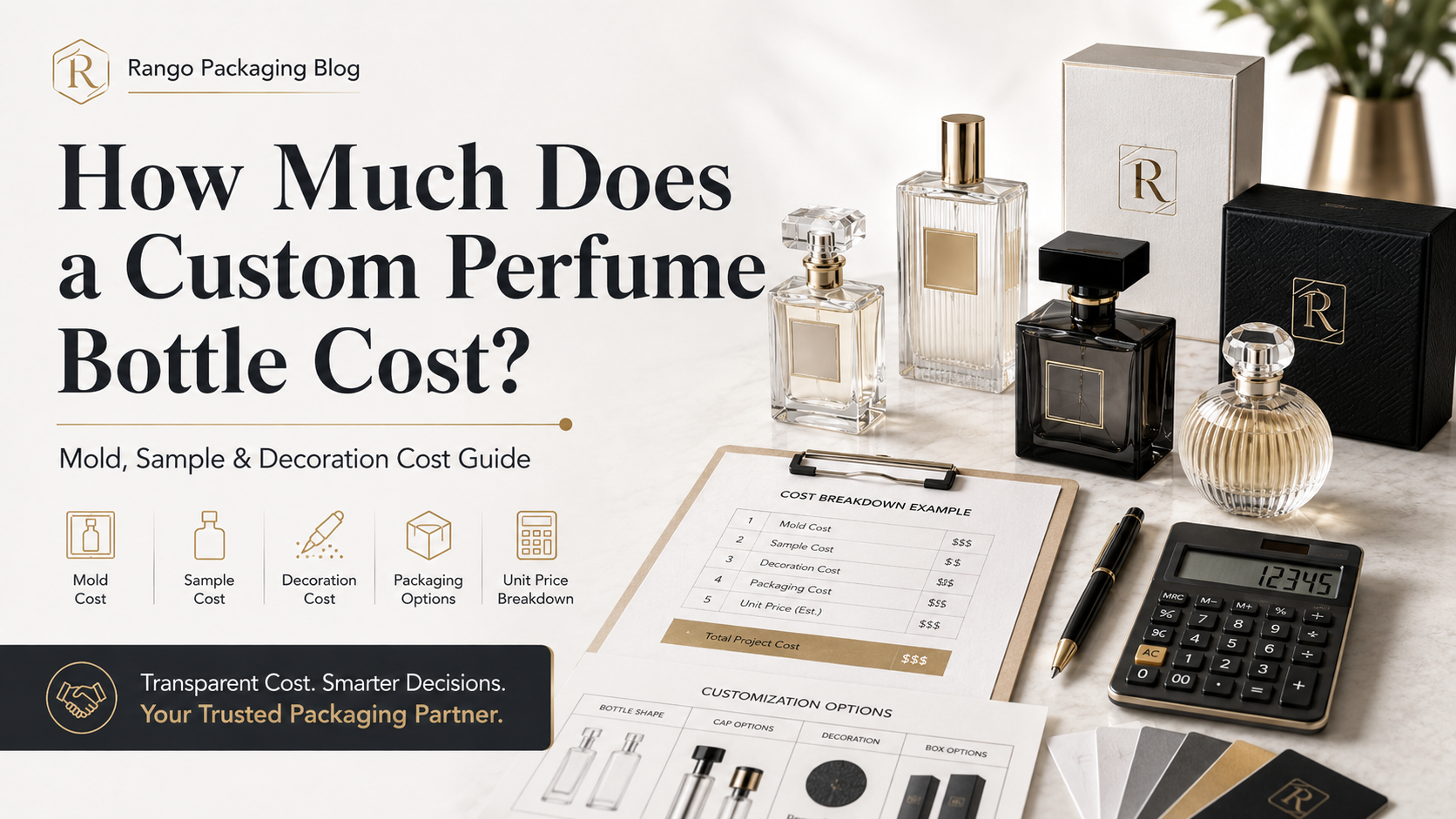
"How much does a custom perfume bottle cost?" has no single answer, but it does have a predictable structure. Once you understand the cost blocks, you can estimate a project before you ever request a quotation.
The four cost blocks
- Tooling (mold) — one-time
- Sampling — one-time
- Bottle production — per piece
- Decoration and components — per piece
1. Mold development
A custom glass mold is a one-time investment tied to a committed production volume. Cost depends on:
- Bottle complexity — a straight-sided rectangle is far cheaper than an asymmetric or heavy-base design
- Number of mold cavities — more cavities mean higher tooling cost but faster output
- Neck standard — using a standard FEA 15 crimp neck avoids extra neck tooling
- Base thickness and weight — heavy-wall "luxury" bases need more material and slower forming
Mold cost is only justified across repeat production runs, so discuss your annual volume commitment first.
2. Sampling
Samples are quoted separately from production. Expect:
- Stock-mold samples: 7–15 days
- Decorated samples: an additional 7–10 days
- First sample from a brand-new mold: 35–55 days
Budget for at least two sampling rounds. One round is optimistic for any project with colour matching or metallised components.
3. Bottle production cost drivers
- Glass weight (grams per bottle) — the single biggest driver
- Glass clarity grade — flint vs extra-white
- Capacity and wall thickness
- Order quantity — unit price drops as quantity rises above the 5,000 pcs standard MOQ
- Reject rate for complex geometry
4. Decoration and components
Each added process adds cost per piece:
- Frosting or matte coating
- Colour spray coating, including gradients
- Silk screen printing (per colour, per position)
- Hot stamping / metallised logo
- Electroplating
- Cap material — ABS, aluminium, zinc alloy or wood
- Pump, collar and dip tube
- Gift box, inner tray, shipping carton
A plain bottle can double in cost once a zinc-alloy cap, a metallised collar and a rigid gift box are added. Always price the assembled unit, not the bottle alone.
Hidden costs buyers forget
- Colour matching rounds and Pantone approvals
- Secondary packaging and inner protection
- Freight volume — bottle shape affects cartons per pallet
- Duties and landed cost
- Safety stock for reorders
Commercial terms
Payment is 30% deposit and 70% balance before shipment. Confirm Incoterms early; the difference between EXW and CIF can be larger than the unit-price difference you spent weeks negotiating.
How to reduce cost without looking cheap
- Keep an existing mold and invest the savings in decoration and the cap
- Reduce glass weight slightly instead of removing a finish
- Consolidate SKUs — fewer variants, deeper runs
- Use one striking process (frosting or hot stamping) rather than three competing ones
The most cost-effective luxury look is almost always a well-chosen existing bottle with excellent decoration — not a bespoke mold produced in small quantity.