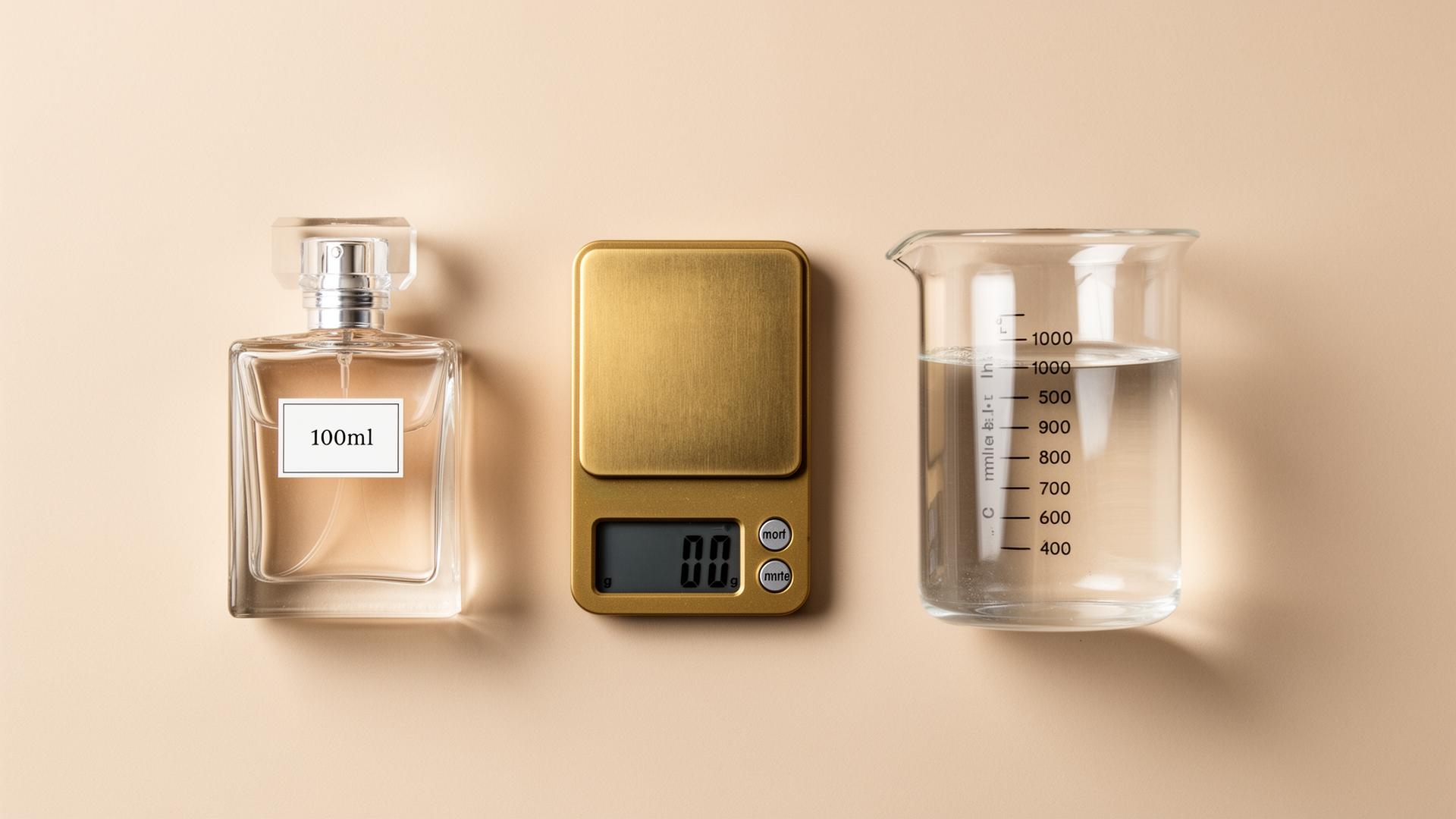
Weight and volume conversion is one of the most common — and most error-prone — calculations in perfume and cosmetic packaging. A 100 ml perfume bottle does not weigh 100 grams. A 1 fl oz roll-on does not hold 30 ml. Mixing up oz (weight, avoirdupois ounce) with fl oz (volume, fluid ounce) routinely causes wrong fill quantities, under-declared net contents, customs disputes, and freight miscalculations.
This guide gives you the exact formulas, density values, and reference tables we use at Jiangsu Rango Packaging when quoting custom perfume bottles, jars, and cosmetic containers for clients in over 60 countries.
Quick reference: ml ⇄ fl oz ⇄ g ⇄ oz
| Volume (ml) | US fl oz | UK fl oz | Water weight (g) | Perfume weight (g, ρ≈0.87) |
|---|---|---|---|---|
| 5 ml | 0.169 fl oz | 0.176 fl oz | 5.00 g | 4.35 g |
| 10 ml | 0.338 fl oz | 0.352 fl oz | 10.00 g | 8.70 g |
| 15 ml | 0.507 fl oz | 0.528 fl oz | 15.00 g | 13.05 g |
| 30 ml | 1.014 fl oz | 1.056 fl oz | 30.00 g | 26.10 g |
| 50 ml | 1.691 fl oz | 1.760 fl oz | 50.00 g | 43.50 g |
| 100 ml | 3.381 fl oz | 3.520 fl oz | 100.00 g | 87.00 g |
| 200 ml | 6.763 fl oz | 7.039 fl oz | 200.00 g | 174.00 g |
| 250 ml | 8.454 fl oz | 8.799 fl oz | 250.00 g | 217.50 g |
| 500 ml | 16.907 fl oz | 17.598 fl oz | 500.00 g | 435.00 g |
Rule of thumb: 1 US fl oz = 29.5735 ml, 1 UK (Imperial) fl oz = 28.4131 ml. Always confirm which "fl oz" your market uses — the US and UK values differ by ~4%.
The two conversions you must keep separate
1. Volume ⇄ Volume (ml ⇄ fl oz)
These are pure unit conversions; density does not matter.
- ml → US fl oz:
ml ÷ 29.5735 - US fl oz → ml:
fl oz × 29.5735 - ml → UK fl oz:
ml ÷ 28.4131 - UK fl oz → ml:
fl oz × 28.4131
2. Volume ⇄ Weight (ml ⇄ g)
This requires density (ρ, in g/ml). The formula is:
mass (g) = volume (ml) × density (g/ml)
Water has a density of exactly 1.000 g/ml at 4 °C, which is why people loosely say "1 ml = 1 g". For perfume, alcohol, oils, creams and serums, that shortcut is wrong.
Density values for common cosmetic & fragrance fills
| Product | Typical density (g/ml) | Notes |
|---|---|---|
| Water (purified) | 1.000 | Reference baseline |
| Eau de Parfum (EDP) | 0.86 – 0.89 | High alcohol + fragrance oil |
| Eau de Toilette (EDT) | 0.85 – 0.88 | Higher alcohol ratio |
| Ethanol (96%) | 0.803 | Common perfume solvent |
| Essential oil (average) | 0.85 – 0.95 | Varies widely by oil |
| Jojoba / argan oil | 0.86 – 0.92 | Carrier oils |
| Glycerin | 1.261 | Heavier than water |
| Body lotion / cream | 0.95 – 1.02 | Emulsions |
| Shampoo / shower gel | 1.02 – 1.05 | Surfactant systems |
| Toner / hydrosol | 0.99 – 1.00 | Mostly water |
| Lip balm (anhydrous) | 0.88 – 0.92 | Wax + oil base |
Worked example. A 50 ml EDP fill at ρ = 0.87 g/ml weighs:
50 × 0.87 = 43.5 g of liquid (not 50 g).
Net contents labeling: what regulators check
Different markets require different units on the front-of-pack net contents declaration:
- EU (Cosmetics Regulation 1223/2009): Metric only —
mlfor liquids,gfor solids/semi-solids. Theemark indicates average-fill compliance. - USA (FDA 21 CFR 701.13 / FPLA): Dual declaration — US customary and metric. Liquids use
fl oz+ml; solids useoz+g. - UK: Metric primary (
ml/g); imperial allowed as a supplementary indication. - Canada: Metric mandatory; bilingual (EN/FR).
- Middle East (GSO 1943): Metric.
Practical tip: when designing for global launch, lead with metric (ml/g) and add
fl ozfor US/UK SKUs. This avoids producing market-specific label artwork for most regions.
Gross weight vs net weight vs filled weight
When you order custom perfume bottles, three different weights show up in quotations, packing lists, and freight documents — keep them straight:
| Term | Definition | Used for |
|---|---|---|
| Empty bottle weight | Glass only, no closure, no fill | Mould engineering, glass cost |
| Net weight (net content) | Weight of the liquid inside | Label declaration, formula cost |
| Filled unit weight | Bottle + closure + cap + liquid | Filling line setup, retail logistics |
| Gross carton weight | Filled units + inner trays + master carton | Freight, palletisation, customs |
Worked example for a 100 ml EDP SKU:
- Empty glass bottle: 180 g
- Crimp pump + actuator + over-cap: 22 g
- Net content (100 ml × 0.87): 87 g
- Filled unit weight: 289 g
- 60 units per master carton + 850 g carton & inserts: 18.19 kg gross
- 20 ft container payload ≈ 21,000 kg → ~1,150 cartons → ~69,000 filled bottles
Container fill volume vs labelled volume (overflow capacity)
A bottle labelled "100 ml" is not filled to the brim. The overflow capacity (also called brimful capacity) is typically 5–15% larger than the nominal fill, to leave headspace for the dip tube, thermal expansion, and dosing tolerance.
| Nominal fill | Typical overflow capacity |
|---|---|
| 30 ml | 32 – 34 ml |
| 50 ml | 53 – 56 ml |
| 100 ml | 105 – 112 ml |
When you receive a sample from a glass factory, the cavity is engineered to the overflow value — never use brimful volume on your label.
Converting freight: ml → CBM and units per container
For sea-freight planning, convert from single-unit dimensions → carton CBM → container loadability.
CBM per carton (m³) = L (m) × W (m) × H (m)
For a typical 100 ml perfume master carton of 38 × 32 × 26 cm:
0.38 × 0.32 × 0.26 = 0.0316 CBM
| Container | Internal volume | Practical CBM (85% util.) | ~Cartons | ~Bottles (60/ctn) |
|---|---|---|---|---|
| 20 ft GP | 33.2 m³ | 28 m³ | 885 | 53,100 |
| 40 ft GP | 67.7 m³ | 58 m³ | 1,835 | 110,100 |
| 40 ft HQ | 76.4 m³ | 65 m³ | 2,055 | 123,300 |
FAQ
Is 1 oz the same as 1 fl oz?
No. oz is a unit of weight (1 oz = 28.3495 g). fl oz is a unit of volume (1 US fl oz = 29.5735 ml). They are numerically close for water but diverge for perfume, oils, and creams.
Why does my 100 ml perfume weigh 87 g, not 100 g?
Because perfume is mostly ethanol (density ≈ 0.80 g/ml) plus fragrance oils. The blended density is around 0.87 g/ml, so 100 ml × 0.87 = 87 g.
How do I convert 1 fl oz of essential oil to grams?
1 US fl oz = 29.5735 ml. Multiply by the oil's density (typically 0.85–0.95). Lavender oil at ρ = 0.885 → 29.5735 × 0.885 ≈ 26.2 g.
What does "100 ml e" mean on a label?
The e (estimated symbol, U+212E) certifies that the average net content of a production batch meets the declared quantity under EU Directive 76/211/EEC, with controlled negative tolerances.
How much does an empty 100 ml glass perfume bottle weigh?
Depending on glass thickness and base design, an empty 100 ml flint-glass perfume bottle typically weighs 150 – 240 g. Heavy-wall luxury bottles can exceed 300 g.
How many 30 ml roll-ons fit in a 20 ft container?
A 30 ml roll-on with cap typically packs ~120 units per master carton at ~0.025 CBM. At 85% container utilisation → ~1,120 cartons → ~134,000 units.
About Rango Packaging
Jiangsu Rango Packaging, founded in 2014, manufactures custom glass perfume bottles, cosmetic jars, and reed-diffuser bottles for brands in 60+ countries. Our engineers handle volume/weight specifications, overflow capacity validation, and filled-unit logistics planning as part of every custom-mould quotation. Browse our stock and custom product range or request a tooling quote with your target fill volume in ml, fl oz, or grams — we will return a complete spec sheet including empty bottle weight, overflow capacity, recommended closure, and container loadability.