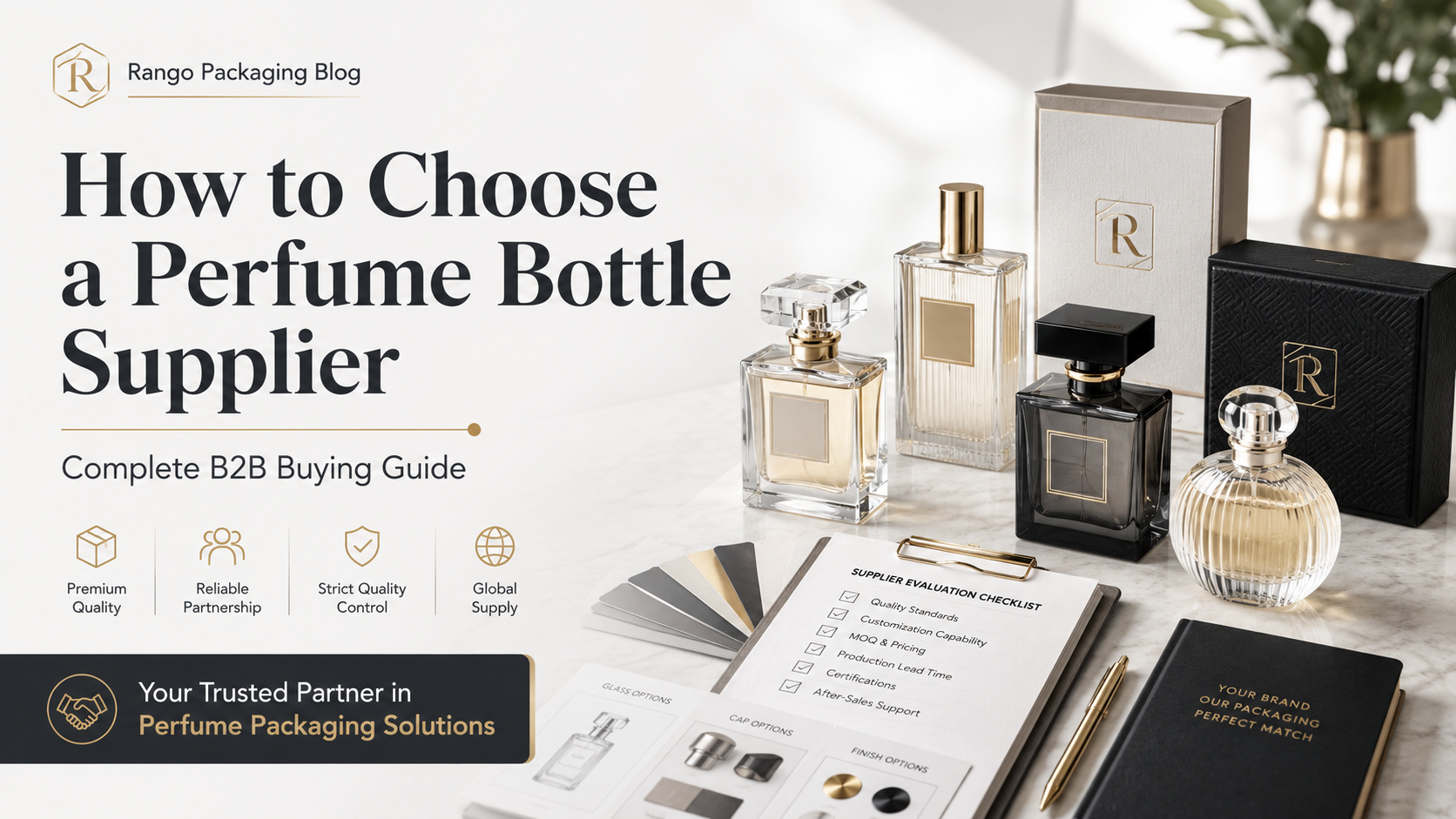
Choosing a perfume bottle supplier is a procurement decision, not a shopping decision. The bottle sets the perceived value of your fragrance, and the supplier behind it sets your lead times, your defect rate and your ability to reorder consistently. This guide covers what to check before you commit to a bulk order.
1. Factory or trading company?
Ask directly whether the company operates its own glass production, its own decoration lines, or neither. A direct factory can control forming tolerances, coating batches and inspection standards. A trading company adds a layer that can be useful for consolidation, but it also adds cost and slows down technical answers.
Practical test: ask for photos of the furnace, the production line, the decoration workshop and the packing area — and ask a technical question such as neck tolerance or annealing time. The speed and specificity of the answer tells you more than any certificate.
2. Confirm MOQ before you fall in love with a design
Standard MOQ for bottles produced from existing molds is 5,000 pcs per SKU. Custom mold projects require a committed volume, because the mold cost only makes sense across repeat production runs. If a supplier quotes an unusually low MOQ for a custom mold, ask who is absorbing the tooling cost and what happens to your mold ownership.
3. Check decoration capability, not just glass
Most quality complaints come from decoration, not the glass body:
- Spray coating (matte, gloss, gradient) — check colour consistency across batches
- Frosting — check evenness and whether the finish resists fingerprints
- Silk screen and hot stamping — check registration accuracy on curved surfaces
- Electroplating and metallised caps — check adhesion and salt-spray behaviour
Always request a decorated sample, not a blank bottle.
4. Sampling and lead times
Realistic timelines you should hear from a serious supplier:
- Stock-mold samples: 7–15 days
- Samples with surface decoration: an additional 7–10 days
- Brand-new custom mold: 35–55 days to first sample
If a supplier promises a custom mold sample in a week, they are describing a 3D print or a modified existing mold — clarify which.
5. Closure and sprayer compatibility
The bottle neck must match the pump system. FEA 15 crimp neck is the dominant standard for perfume. Confirm the neck finish, the collar diameter and whether the supplier can supply assembled pumps, collars and caps as a matched set. Sourcing bottle and pump separately is where most leakage and fitment problems begin.
6. Quality control and documentation
Ask what happens at each stage: dimensional check after forming, visual inspection after decoration, and AQL sampling before packing. Ask which AQL level applies for critical, major and minor defects, and whether you receive an inspection report before shipment.
7. Payment and commercial terms
Standard terms in this industry are 30% deposit and 70% balance before shipment. Clarify Incoterms (EXW, FOB, CIF), packing specification, carton dimensions and pallet configuration early — these affect your landed cost more than a small unit-price difference.
8. Reorder consistency
A first order that looks perfect means little if batch two is a different shade of frost. Ask how colour standards are stored, whether master samples are retained, and how long molds are kept for repeat orders.
Quick supplier checklist
- Own factory and decoration capability confirmed
- MOQ and mold ownership documented in writing
- Decorated sample approved before mass production
- Neck standard and pump compatibility confirmed
- Inspection standard and report agreed
- 30/70 payment terms and Incoterms confirmed
- Master sample retained for reorders
Work through the list once and you avoid the three failures that actually damage brands: late delivery, inconsistent finish, and packaging that costs more than the margin allows.