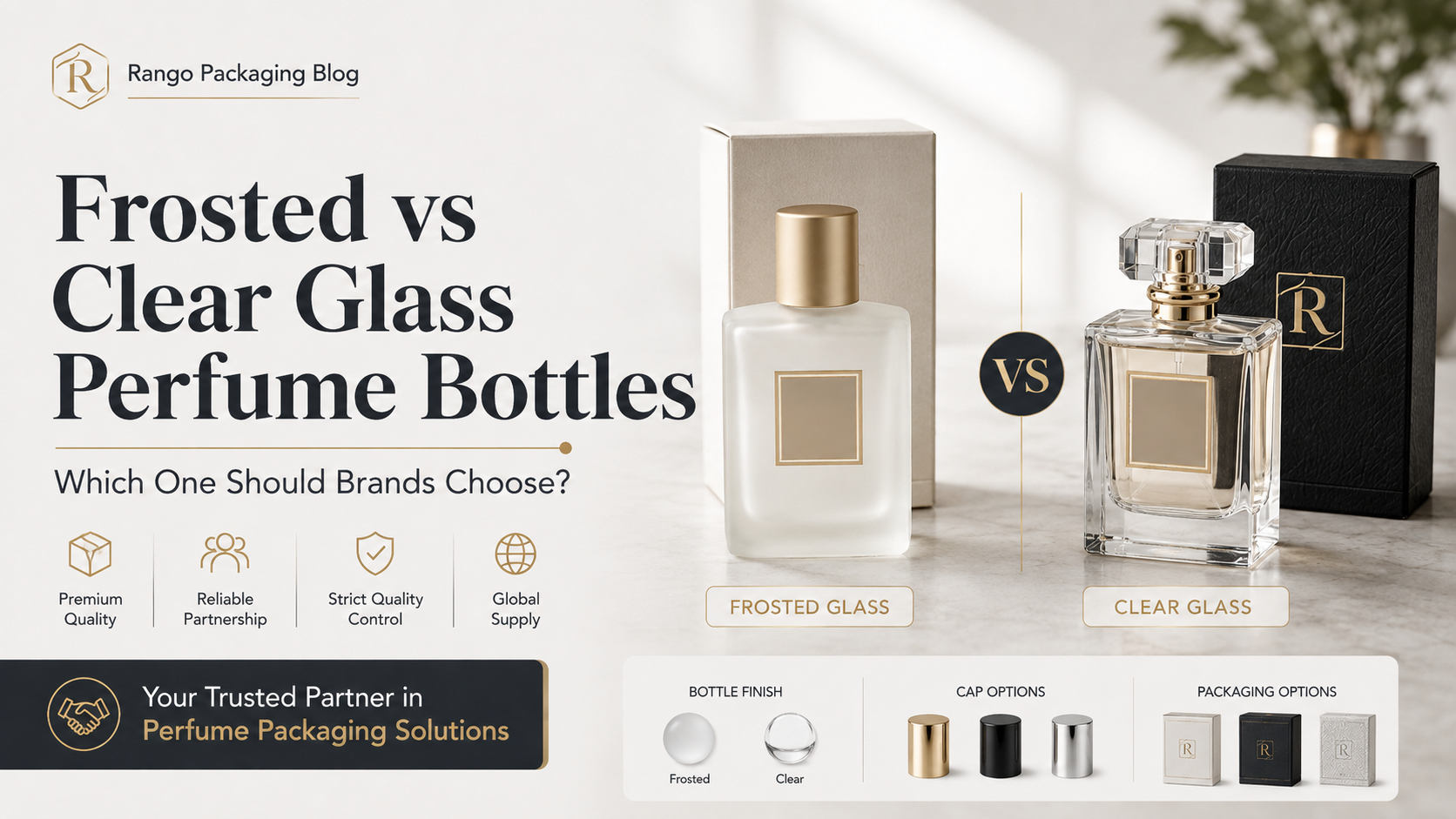
Frosted or clear? It looks like a styling question, but it changes decoration options, cost and even how customers perceive the juice inside.
Clear glass
Clear (flint or extra-white) glass shows the fragrance itself. The liquid colour becomes part of the design.
Strengths
- Displays juice colour and fill level
- Highest perceived clarity and brightness under retail lighting
- Ideal base for gradient spray coating, hot stamping and metallised caps
- Generally the lowest-cost starting point
Considerations
- Shows fingerprints and any imperfection in the glass
- Reveals sediment in natural or oil-based formulas
- Less light protection for sensitive formulations
Frosted glass
Frosting produces a soft matte surface, either by acid etching or by a matte coating.
Strengths
- Soft, tactile, quietly premium hand-feel
- Diffuses light and hides minor glass imperfections
- Excellent contrast background for printed or hot-stamped logos
- Conceals juice colour when the formula is not visually attractive
Considerations
- Adds a decoration step and therefore cost and lead time
- Coating-based frosting can mark with fingerprints unless a protective finish is used
- Batch-to-batch evenness must be controlled — always approve a physical sample
Decoration compatibility
| Process | Clear glass | Frosted glass |
|---|---|---|
| Silk screen | Excellent | Excellent, high contrast |
| Hot stamping | Excellent | Excellent |
| Gradient spray | Excellent | Possible, softer effect |
| Full colour coating | Excellent | Redundant — coating replaces frost |
| Metallised cap pairing | Strong contrast | Understated, tonal |
Which suits which positioning?
- Fresh, citrus, transparent fragrances — clear glass emphasises lightness
- Oud, amber, gourmand, niche — frosted supports depth and discretion
- Unisex minimalist lines — frosted with a single hot-stamped logo
- Value or travel ranges — clear glass keeps cost efficient
Sourcing notes
Both options are produced from the same bottle molds; frosting is a surface process applied afterwards. That means you can test both finishes from one existing mold without new tooling. Standard MOQ is 5,000 pcs per SKU — remember that clear and frosted versions of the same bottle count as two SKUs.
Sampling timelines: stock-mold samples in 7–15 days, with frosting or other decoration adding 7–10 days.
Recommendation
If you are undecided, order decorated samples in both finishes from the same mold and view them under real retail lighting alongside your cap and box. The decision usually becomes obvious within seconds — and it costs far less than discovering it after a 5,000-piece run.