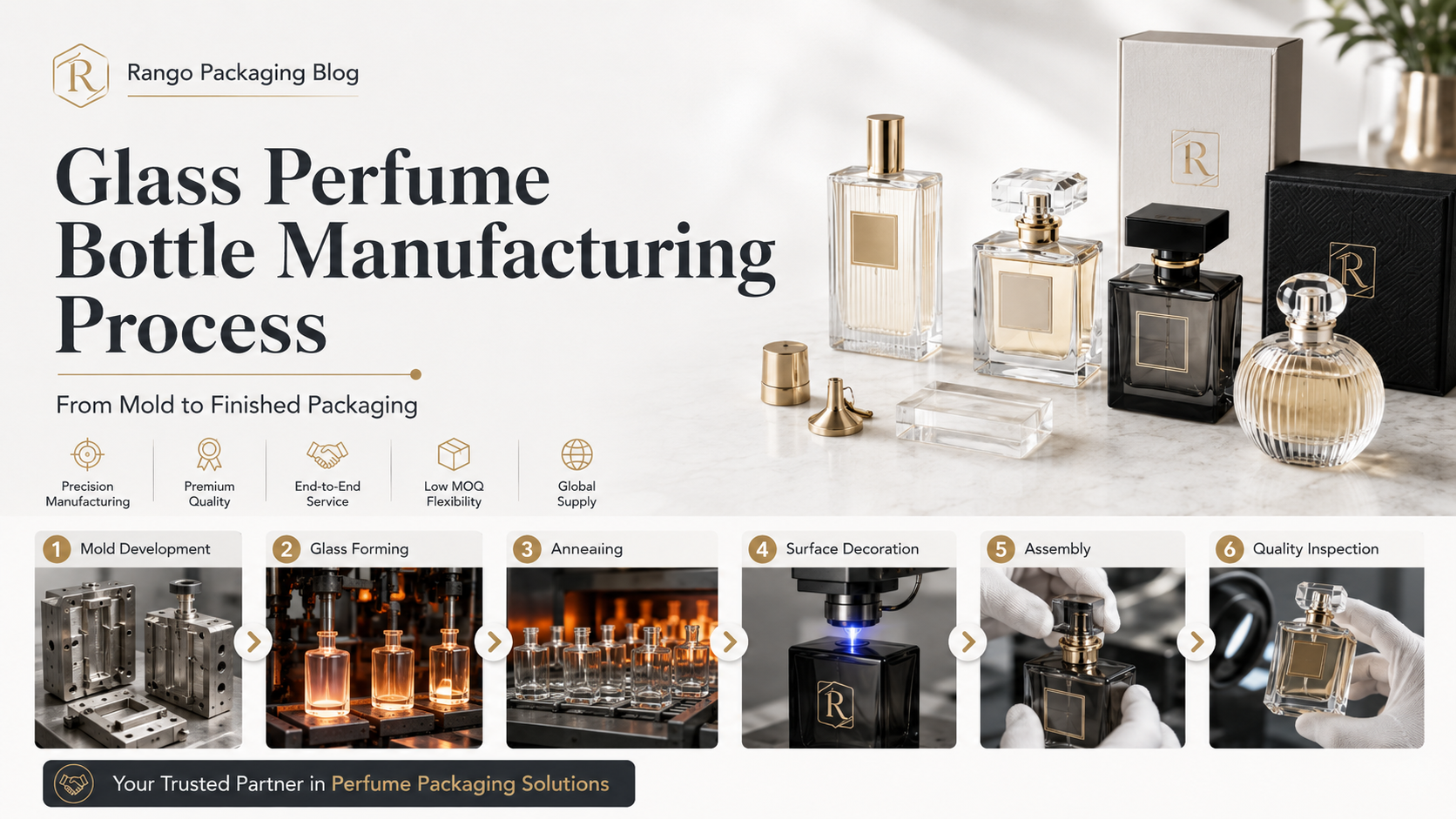
Understanding how a glass perfume bottle is actually made helps buyers write better specifications, judge lead times realistically, and identify where defects come from.
1. Design and mold development
Everything starts with a 2D drawing and a 3D model that define capacity, wall thickness, base geometry and neck standard. The mold is then machined in steel. For a brand-new mold, expect 35–55 days before the first sample.
Using an existing mold skips this stage entirely — which is why stock-mold projects reach sampling in 7–15 days.
2. Batch preparation and melting
Silica sand, soda ash, limestone and cullet are weighed and melted in the furnace at roughly 1,500 °C. Consistency of the batch is what keeps glass clarity stable between production runs. Extra-white (low-iron) glass is used where a clean, colourless appearance matters.
3. Forming
Molten glass is cut into gobs and formed into bottles, typically by press-and-blow or blow-and-blow. This stage determines:
- Wall thickness distribution
- Base weight and stability
- Neck finish accuracy — critical for crimp pump fitment
- Shoulder definition on faceted designs
4. Annealing
Bottles pass through an annealing lehr where temperature is reduced gradually. This releases internal stress. Skipped or rushed annealing produces bottles that crack later in filling lines or during transport — a defect invisible at inspection.
5. Surface decoration
Decoration is where a plain container becomes brand packaging:
- Frosting — acid or coating-based matte finish
- Spray coating — solid colours and gradients
- Silk screen printing — logos and text, one screen per colour
- Hot stamping — metallic gold or silver detail
- Electroplating / metallisation — mirror finishes on caps and collars
Each process is followed by curing or baking, and each adds lead time — typically 7–10 days on top of a plain sample.
6. Component matching and assembly
Pumps, collars, dip tubes and caps are matched to the bottle neck (FEA 15 crimp is the perfume standard). Crimping tension is checked so the pump seals without stressing the glass. Caps in ABS, aluminium, zinc alloy or wood are fitted and checked for concentricity.
7. Quality inspection
Inspection runs at multiple points, not just at the end:
- Dimensional check after forming — capacity, height, neck diameter
- Stress check after annealing
- Visual check after decoration — colour deviation, print registration, pinholes
- Leak and spray test on assembled units
- AQL sampling before packing
8. Packing and shipping
Bottles are packed with inner trays or partitions, cartons are marked, and pallet configuration is confirmed. Carton dimensions matter: they decide how many units fit a container and therefore your landed cost.
What this means for buyers
- Ask which stages happen in-house — glass, decoration, assembly
- Approve a decorated sample, not a blank bottle
- Treat annealing and crimping as quality questions, not technical trivia
- Expect 30% deposit, 70% balance before shipment as standard terms
A supplier who can walk you through every one of these stages with their own photos is a supplier who controls the outcome.