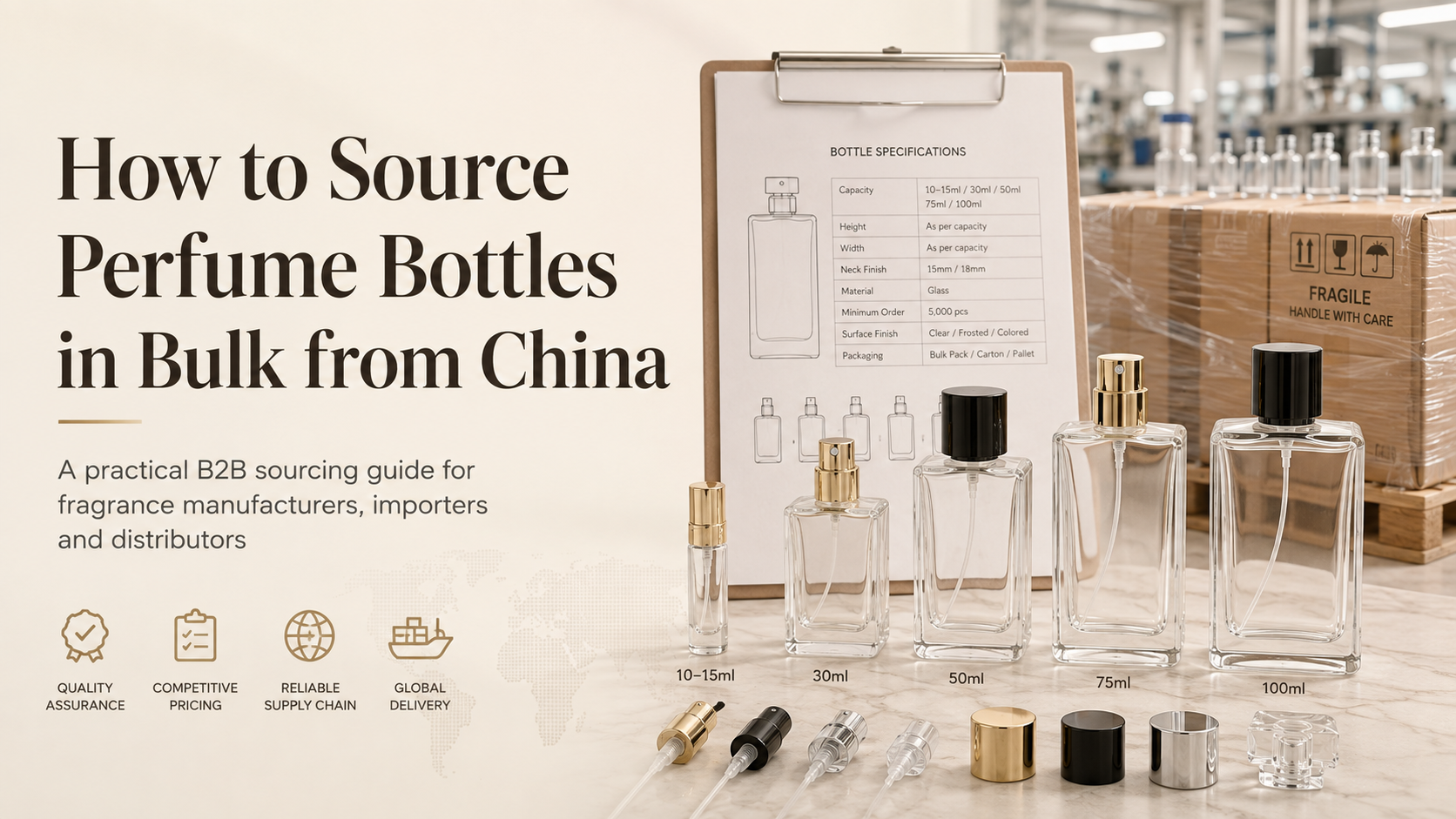
How to Source Perfume Bottles in Bulk from China
Sourcing perfume bottles in bulk from China is much easier when the buyer already knows the basic requirements: bottle capacity, approximate shape, purchase quantity, pump and cap requirements, and the destination market.
For professional fragrance manufacturers, importers, distributors and established brands, the fastest sourcing route is often to start with an existing-mould perfume bottle before considering a completely new custom mould.
This guide explains how to prepare a bulk perfume bottle RFQ, compare suitable suppliers, approve samples and move into production efficiently.
1. Start With a Clear Bottle Requirement
Before contacting a supplier, prepare the basic specifications for the bottle you need.
The most useful information includes:
- Bottle capacity
- Reference photo or existing bottle
- Required quantity
- Bottle shape
- Neck finish
- Pump requirement
- Cap requirement
- Decoration requirement
- Destination country
- Required delivery schedule
A reference image is especially useful.
If you already have a bottle used in your current product line or a competitor bottle with similar proportions, send the photo to the supplier. The manufacturer can then check whether an existing mould is available with a similar shape.
This is often faster than starting a completely new bottle development project.
2. Decide Between an Existing Mould and a New Custom Mould
There are two common sourcing routes.
Existing-Mould Perfume Bottles
Browse our existing perfume bottle models to compare available shapes and capacities.
An existing-mould bottle already has production tooling available.
This option is usually suitable when the buyer needs:
- Faster sourcing
- Lower development cost
- Samples before bulk production
- Established bottle dimensions
- Commercial quantities for repeat purchasing
Existing-mould bottles are available in many common capacities, including:
- 15ml
- 30ml
- 50ml
- 75ml
- 100ml
For existing bottle designs, Rango Packaging's standard MOQ is generally 5,000 pcs per model.
Custom-Mould Perfume Bottles
A completely new bottle shape requires new mould development.
This route is more suitable when the bottle itself must be proprietary.
Custom projects involve additional:
- Tooling cost
- Development time
- Sample approval
- Production feasibility review
For a new custom bottle project, the buyer should provide a suitable STEP/STP 3D file before mould development.
If your priority is purchasing efficiency rather than creating a proprietary bottle shape, checking existing moulds first is usually the better starting point.
3. Confirm the Actual Purchase Quantity
A supplier needs the real planned quantity to prepare an accurate quotation.
Instead of asking only:
What is your lowest price?
Provide a quantity such as:
- 10,000 pcs
- 30,000 pcs
- 50,000 pcs
- 100,000 pcs
The actual purchase quantity affects:
- Production planning
- Component sourcing
- Decoration cost
- Packing cost
- Unit price
For a professional RFQ, it is better to request pricing based on the quantity you realistically expect to purchase.
4. Decide Whether You Need the Bottle Only or a Complete Set
Perfume packaging sourcing often involves more than the glass bottle.
A complete fragrance packaging set may include:
Glass Bottle + Fine-Mist Pump + Collar + Cap
For most commercial fragrance projects, these components need to be checked as a complete system.
The buyer should confirm:
- Bottle neck finish
- Pump size
- Collar finish
- Cap material
- Cap dimensions
- Assembly compatibility
FEA15 is a common neck finish for fine-fragrance glass bottles.
Pump and cap selection should be confirmed together with the bottle before bulk production.
5. Choose the Cap Material
The cap can significantly affect the final appearance and cost of a perfume package.
Common options include:
- ABS
- Aluminium
- Magnetic caps
- Zinc alloy
- Wood
- Other project-specific materials
When requesting a quotation, specify whether you already have a preferred cap style.
If you do not, the supplier can recommend compatible caps based on the bottle neck and overall dimensions.
For large-volume sourcing, using an existing compatible cap can usually reduce development time.
6. Confirm Decoration Requirements Early
Common perfume bottle decoration options include:
- Color Coating
- Frosted
- Silk Screen Printing
- Hot Stamping
- Label
- Laser Engraving
Decoration should be discussed before the final quotation because it affects both cost and production lead time.
For example, a clear glass bottle without decoration will have a different production process from a bottle requiring color coating, logo printing and hot stamping.
The buyer should provide:
- Target color
- Logo artwork
- Printing position
- Reference sample if available
7. Request Samples Before Bulk Production
For an existing-mould bottle, a physical sample allows the buyer to evaluate:
- Glass clarity
- Bottle weight
- Shape and proportions
- Neck finish
- Pump compatibility
- Cap fit
- Overall appearance
Existing-mould samples can generally be arranged before bulk production. Rango's current sourcing information states that standard existing-mould samples typically ship in approximately 7–15 days, depending on availability.
If decoration is required, a separate decorated sample may be needed after the bottle and components are confirmed.
For large B2B orders, approving the actual components before mass production is an important step.
8. Check the Supplier's Production Capability
For a bulk perfume bottle order, buyers should evaluate more than the product photo.
Important questions include:
- Is the bottle produced from an existing mould?
- Can the supplier support repeat production?
- Can pumps and caps be matched?
- How are bottles inspected?
- How are export cartons packed?
- Can palletized export packing be provided?
- Which FOB ports are available?
You can also review our perfume bottle manufacturing and quality control process.
Rango's manufacturing information describes production, inspection, component matching and palletized export packing for wholesale perfume bottle programs.
For repeat purchasing, stable mould availability and component consistency are particularly important.
9. Confirm Packing Before Shipping
Glass perfume bottles require suitable export packing.
Typical bulk packing may include:
- Partitioned export cartons
- Internal dividers
- Palletized cartons
- Shrink wrapping
- Container loading
Packing should be confirmed according to:
- Bottle weight
- Bottle shape
- Decoration
- Cap configuration
- Shipping method
Heavy or decorated bottles may require additional protection.
10. Understand FOB Purchasing
For professional international perfume bottle purchasing, FOB is a common commercial term.
Under FOB terms, the supplier prepares the goods for export and delivers them according to the agreed FOB port.
Common ports for perfume bottle shipments from China include:
- Shanghai
- Ningbo
The buyer should normally have a freight forwarder or shipping agent to arrange the international transportation.
Before placing the order, confirm:
- FOB port
- Carton dimensions
- Gross weight
- Pallet requirements
- Estimated shipment volume
- Production completion date
This allows the freight forwarder to prepare the shipment in advance.
11. A Good Bulk Perfume Bottle RFQ Should Include
A professional inquiry can be very simple.
For example:
Capacity: 100ml Quantity: 50,000 pcs Bottle: Clear glass, existing mould preferred Reference: Attached photo Pump: FEA15 fine-mist pump Cap: Aluminium cap Decoration: No decoration Destination: Brazil Trade Term: FOB
With this information, a supplier can immediately check suitable bottle options and start preparing samples and pricing.
Without capacity, quantity or a reference product, the sourcing process usually takes longer.
12. Recommended Bulk Sourcing Process
A practical sourcing process looks like this:
Step 1 — Send the Reference
Provide the bottle image, capacity and required quantity.
Step 2 — Check Existing Moulds
The supplier checks available bottles with similar proportions.
Step 3 — Confirm Components
Select the pump, collar and cap.
Step 4 — Approve Samples
Evaluate the actual bottle and components.
Step 5 — Confirm Final Specification
Confirm decoration, packing and purchase quantity.
Step 6 — Receive the Final Quotation
Pricing is calculated according to the confirmed bottle, components, quantity and packing requirements.
Step 7 — Bulk Production
Production starts according to the approved specification and agreed commercial terms.
Bulk Perfume Bottle Sourcing from China
If you already know the bottle capacity, approximate design and purchase quantity, the fastest next step is to send your reference product for evaluation.
Rango Packaging supplies existing-mould glass perfume bottles with compatible pumps and caps for professional fragrance purchasing programs.
For orders from 10,000 to 100,000+ pcs, visit:
Bulk Perfume Bottle Supply for Manufacturers & Importers
https://rangopack.com/lp/bulk-perfume-bottle-supply
Send your bottle reference, capacity and actual purchase quantity to receive suitable sourcing options.