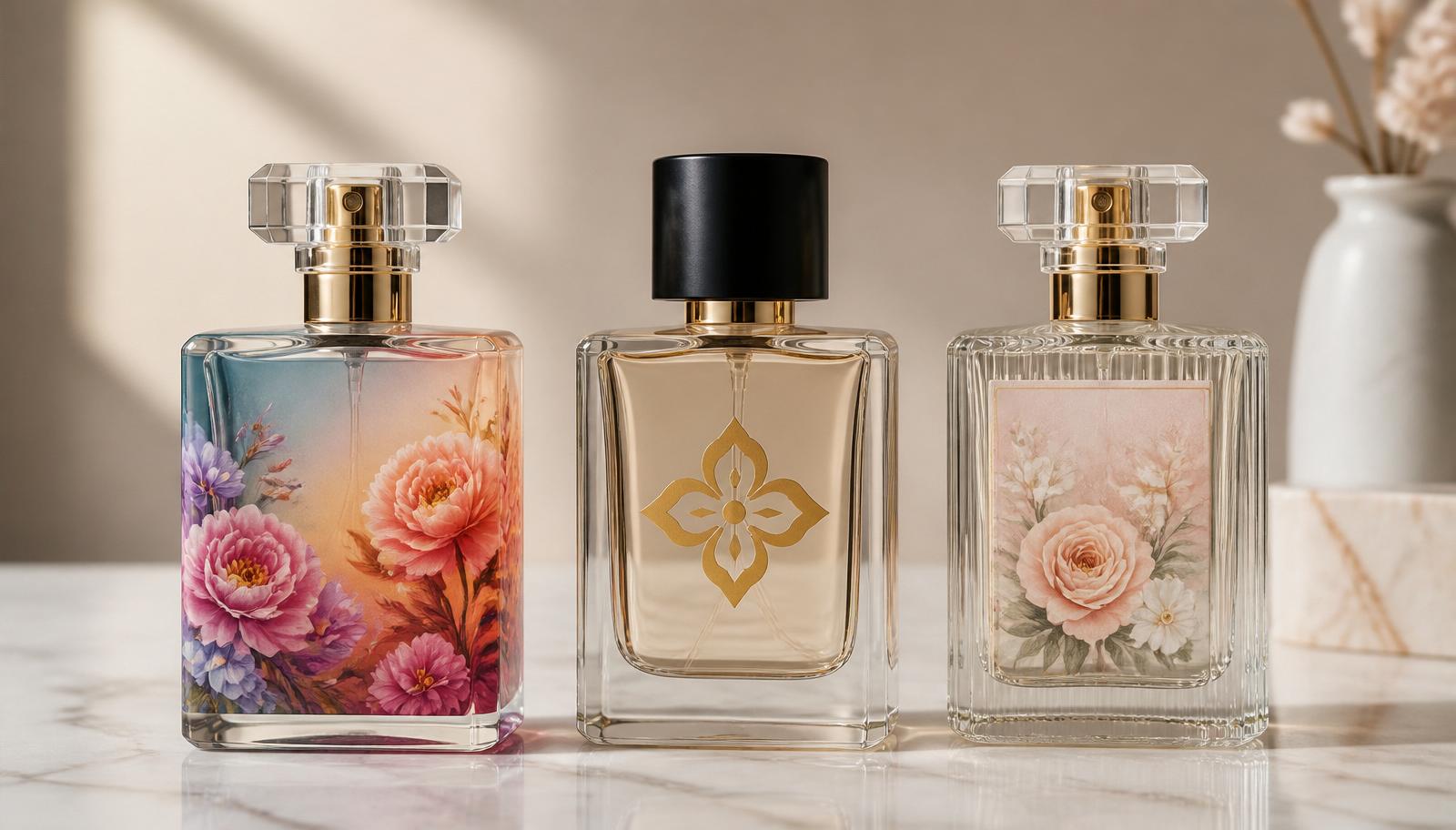
Choosing the right perfume bottle printing method makes or breaks a fragrance launch. Whether you need photo-realistic gradients for a niche collection or a single crisp gold logo for a luxury flagship, the three workflows that dominate perfume bottle printing today — digital UV printing, flexographic (flexo) printing, and silk-screen printing — each carry very different cost, color, and durability trade-offs. This guide breaks down the 5 core pros and cons of each method so you can match the right decoration to your bottle, MOQ, and brand story before you sign the first artwork file.
At Rango Packaging, we run all three lines in-house in our Xuzhou factory, decorating more than 30 million glass perfume bottles a year for niche houses, private-label brands, and large beauty groups. The comparison below is the same one we walk new clients through during sampling.
Quick Comparison Table
| Criteria | Digital UV | Silk Screen | Flexo |
|---|---|---|---|
| MOQ (per design) | 500 pcs | 5,000 pcs | 20,000 pcs |
| Setup cost | Very low | Medium (screen per color) | High (plate per color) |
| Color count | Unlimited (CMYK + W) | 1–6 spot colors | 1–8 spot colors |
| Photo / gradient | Excellent | Poor | Fair |
| Tactile feel | Flat, smooth | Raised, premium | Flat, light |
| Durability (alcohol & abrasion) | Good with primer | Excellent | Good |
| Lead time after artwork | 5–7 days | 10–12 days | 12–15 days |
| Best for | Short runs, complex art | Luxury logos, Pantone matches | Wraparound labels, mid runs |
1. Digital UV Printing on Perfume Bottles
Digital printing on glass uses a flatbed or rotary UV inkjet head that lays CMYK (plus white) droplets directly onto the bottle, then cures them with UV light. No screens, no plates — your artwork goes straight from PDF to bottle.
Pros
- No tooling cost. Switching from one SKU to another is a software change, not a plate change. Ideal for 5,000–10,000 pc runs.
- Unlimited colors and gradients. Photographs, watercolor florals, soft fades, multi-language copy — anything that prints on paper can print on glass.
- Fast sampling. We can deliver a real printed sample in 5–7 days, often the same week your AI brief lands in our inbox.
- Easy versioning. Influencer editions, regional language variants, and limited drops can share one base bottle with different prints.
- Lower waste. No screens or plates to discard at the end of the run, which is increasingly important for sustainability-led brands.
Cons
- Higher unit cost above ~10,000 pcs versus screen or flexo.
- Flatter finish. The ink layer is thin, so it lacks the tactile, slightly raised feel that luxury buyers associate with screen printing.
- Pantone matching is approximate. CMYK simulation can drift 1–2 shades on specific spot colors (especially metallic gold, neon, and corporate blues).
- Requires primer on most glass. Without a UV-bond primer, alcohol-based fragrance contact can degrade adhesion over 12+ months.
- Metallics and true white opacity still trail silk screen — a digital "gold" is closer to mustard than mirror gold.
Best for: niche launches, crowdfunding editions, gradient artwork, photographic packaging, and any brand printing fewer than 5,000 pcs per design.
2. Silk Screen Printing on Perfume Bottles
Silk-screen (serigraphy) pushes thick, opaque ink through a fine mesh stencil — one screen per color — directly onto the bottle. The bottle is then passed through a heat tunnel (typically 580–620°C for ceramic inks, or 150–180°C for organic inks) to fuse the ink into the glass surface.
Pros
- Iconic luxury feel. The ink layer is thick enough to feel under the fingertip — the same finish you see on Chanel, Dior, and Tom Ford bottles.
- Outstanding Pantone accuracy. Each color is mixed to a specific Pantone or in-house formula, so the brand red on bottle #1 matches bottle #500,000.
- High opacity on dark glass. A single pass of opaque white on amber or black glass is fully covered — digital often needs two layers.
- Excellent durability. Properly fired ceramic ink survives alcohol, abrasion, and dishwasher cycles, with >100 rub tests per ISO 2836.
- Special effects unlock here: metallic gold, mirror silver, fluorescent, soft-touch matte, and even tactile braille can all be screened.
Cons
- One screen per color. A 4-color logo means 4 screens, 4 setups, and 4 print stations — costs rise quickly above 2 colors.
- Higher MOQ. Around 5,000 pcs per design is the realistic break-even point.
- Not for photographs. Gradients have to be approximated with halftone dots, which look coarse compared to digital.
- Longer lead time. Screen making, color mixing, and firing add 10–12 days after artwork approval.
- Tighter artwork rules. Minimum line weight is around 0.15 mm; very fine serif text can fill in during firing.
Best for: luxury and prestige fragrances, established brands with strict Pantone guidelines, designs with 1–4 spot colors, and any bottle where the customer should feel the print.
3. Flexographic (Flexo) Printing
Flexo printing uses a flexible photopolymer plate wrapped around a cylinder to transfer ink onto labels — or, for perfume packaging, onto shrink sleeves, pressure-sensitive labels, and wraparound films that are then applied to the bottle. Direct flexo onto glass is rare; flexo's role in perfume is decorating the label that wraps the glass.
Pros
- Very fast at scale. Once the press is running, output is measured in hundreds of meters per minute — perfect for runs of 50,000+ labels.
- Lowest per-unit cost at volume. Beyond ~20,000 pcs, flexo undercuts both screen and digital on label decoration.
- Works on flexible substrates. PET, BOPP, paper, and metallized films open up textures (kraft, holographic, soft-touch) that you cannot put directly on glass.
- Good color consistency. Anilox roll control keeps ink density stable across long runs.
- Combines well with foil stamping and embossing in the same pass on a hybrid press.
Cons
- High plate cost. A new plate per color per SKU is expensive; small runs are uneconomical.
- Not direct-to-glass. The bottle still needs a labeling step, which adds an application line and a small risk of bubbles or misalignment.
- Limited fine detail. Flexo dot gain is higher than offset or digital — text under 5 pt and 1-pixel lines can break.
- Sleeve and label add visible seams that some luxury brands want to avoid.
- Color matching depends on the substrate. The same Pantone looks different on white BOPP vs. clear PET vs. metallized film, so dummies are essential.
Best for: mid-market and mass-market fragrances, multi-language regional rollouts, body mists and EDT lines with wraparound shrink sleeves, and any project where the decoration is on a label rather than the glass itself.
How to Choose: A Practical Decision Tree
- MOQ under 5,000 pcs, or photographic / gradient artwork? → Digital UV.
- MOQ 5,000–30,000 pcs, 1–4 spot colors, luxury tactile feel required? → Silk screen.
- MOQ above 20,000 pcs, decoration on a wraparound label or shrink sleeve? → Flexo.
- Mixed needs (e.g. screen-printed logo + digital seasonal artwork + flexo neck label)? Combine all three on the same bottle — we do this routinely for prestige clients.
Common Hybrid Combinations We Recommend
- Screen-printed brand logo + digital seasonal art. Keeps the iconic luxury feel of the master logo while letting marketing refresh the rest cheaply.
- Frosted glass + screen-printed white + hot-stamped gold cap band. A go-to for niche oud houses.
- Clear glass + full-wrap digital + flexo shrink-sleeve neck tag for regulatory information in 6 languages.
Artwork Checklist Before You Print
- Vector files (AI, EPS, PDF) with all fonts outlined.
- Pantone Solid Coated reference for every spot color.
- Die-line showing exactly where ink can sit on the bottle (avoid the parting line and base).
- Minimum line weight: 0.15 mm for screen, 0.1 mm for digital, 0.2 mm for flexo.
- For digital UV, supply 300 dpi raster artwork at final size.
- Confirm whether you want a primer + protective topcoat (recommended for any alcohol-contact area).
Frequently Asked Questions
Is digital printing on perfume bottles waterproof and alcohol-resistant? Yes, provided we apply a UV bond primer and a protective topcoat. Without those layers, alcohol-based perfume can compromise adhesion within a year.
Can you Pantone-match a brand color in digital UV? We can simulate ~85% of the Pantone Solid Coated library within Delta E ≤ 3. Critical brand colors (gold, fluorescent, deep navy) are safer in silk screen.
What is the smallest text size you can print? 4 pt for digital UV, 5 pt for screen (sans-serif), 6 pt for flexo.
Do you offer metallic gold and silver? Yes — true metallic gold and silver are silk-screen-only on glass. Digital "metallics" are simulated and look matte.
How long does a printed perfume bottle last? Properly cured screen printing on glass passes 100+ rub cycles (ISO 2836) and lasts the full shelf life of the fragrance. Digital UV with primer + topcoat passes the same tests.
Next Step
Send your artwork or even a hand sketch to sales@rangopack.com with your target MOQ, and we will recommend the most cost-effective printing method, mock up a digital proof within 24 hours, and ship a real printed sample within 7 days.
Ready to start your project? Get a free custom perfume bottle quote in 24 hours →
Factory-direct pricing · MOQ from 5,000 pcs · Free digital proof within 24 hours.