
Perfume bottles and atomizers are the two physical objects that turn a fragrance from a liquid into a daily ritual. The bottle stores and preserves the juice; the atomizer (also called a sprayer or pump) breaks the liquid into a fine mist on skin. Together they account for 30–60% of a fragrance''s perceived value — which is why both indie founders and global houses obsess over them.
This guide answers the questions buyers, collectors and brand owners ask most: what kinds exist, what they cost, how refilling works, what is TSA-legal, and how factories like Jiangsu Rango Packaging (founded 2014, exporting to 60+ countries) actually produce them.
Quick facts
| Topic | Answer |
|---|---|
| Most common bottle material | Flint (clear) glass, 30–100 ml |
| Standard pump neck | FEA 15 (crimp), 15 mm |
| Typical spray volume | 0.07–0.10 ml per actuation |
| Travel atomizer capacity | 5–10 ml (TSA-legal under 100 ml / 3.4 fl oz) |
| Refillable bottle lifespan | 5–10+ years with proper care |
| Custom mould cost (factory) | USD 2,000–8,000 |
| Custom MOQ | 20,000–30,000 pcs |
1. What is a perfume bottle?
A perfume bottle is a sealed glass (occasionally crystal or PET) container designed to protect fragrance from light, heat and oxygen — the three things that degrade scent. A proper perfume bottle has three parts:
- The flacon — the glass body, usually flint or extra-flint glass for clarity.
- The closure — a crimp or screw pump, plus a decorative cap (Surlyn, Zamac, wood, ABS).
- The dip tube — a thin plastic straw that draws liquid up to the pump.
Standard capacities: 30 ml, 50 ml, 100 ml. Niche and luxury houses also use 75 ml and 200 ml.
2. What is an atomizer?
An atomizer is the mechanism that turns liquid into spray. Modern fragrance atomizers are precision pumps that deliver a measured dose (typically 0.07–0.10 ml) of fine mist with each press. There are four main types:
| Atomizer type | How it works | Best for |
|---|---|---|
| Crimp pump (FEA 15) | Aluminium collar crimped onto the bottle neck | 95% of modern Eau de Parfum / Eau de Toilette |
| Screw pump | Screws onto a threaded neck (often 18/415) | Refillable bottles, room sprays |
| Vintage bulb atomizer | Rubber bulb pushes air through a mesh nozzle | Decorative / collector pieces |
| Travel / refillable atomizer | Self-contained 5–10 ml pump with bottom valve | TSA-friendly travel |
3. Bottle types you''ll see on the market
Heavy-base luxury flacon
Thick, weighty base (often 15–25 mm of solid glass) that signals premium positioning. Used by most designer and niche houses (Tom Ford, Dior, Creed-style builds).
Cylindrical & minimalist
Straight-walled, clean lines — popular with modern niche and clean-beauty brands (Le Labo, Maison Margiela ''Replica'' style).
Frosted / coloured glass
Glass treated with acid etch or spray-coated in any Pantone colour. Hides the liquid (useful for darker fragrances) and adds tactile feel.
Crystal & decorative flacons
Lead-free crystal or hand-blown art pieces, often refillable. Many become collectibles — vintage Lalique or Baccarat-housed fragrances regularly resell for 3–10× retail.
Refillable travel atomizers
Pocket-sized 5 ml or 10 ml metal tubes with a one-way bottom valve. You press the tube''s base onto a full-size bottle''s nozzle 5–15 times to fill — no funnels, no spills. TSA and IATA legal at any normal travel size.
Roll-ons
Small bottle with a stainless-steel or glass ball — for oil-based perfumes and attars. No propellant, no spray, very travel-safe.
4. Materials and finishes
| Component | Common materials |
|---|---|
| Bottle | Flint glass, extra-flint glass, crystal, frosted glass, coloured glass, PET (sample sizes only) |
| Cap | Surlyn (clear/heavy), Zamac (metal weight), ABS, wood, ceramic, magnetic-close |
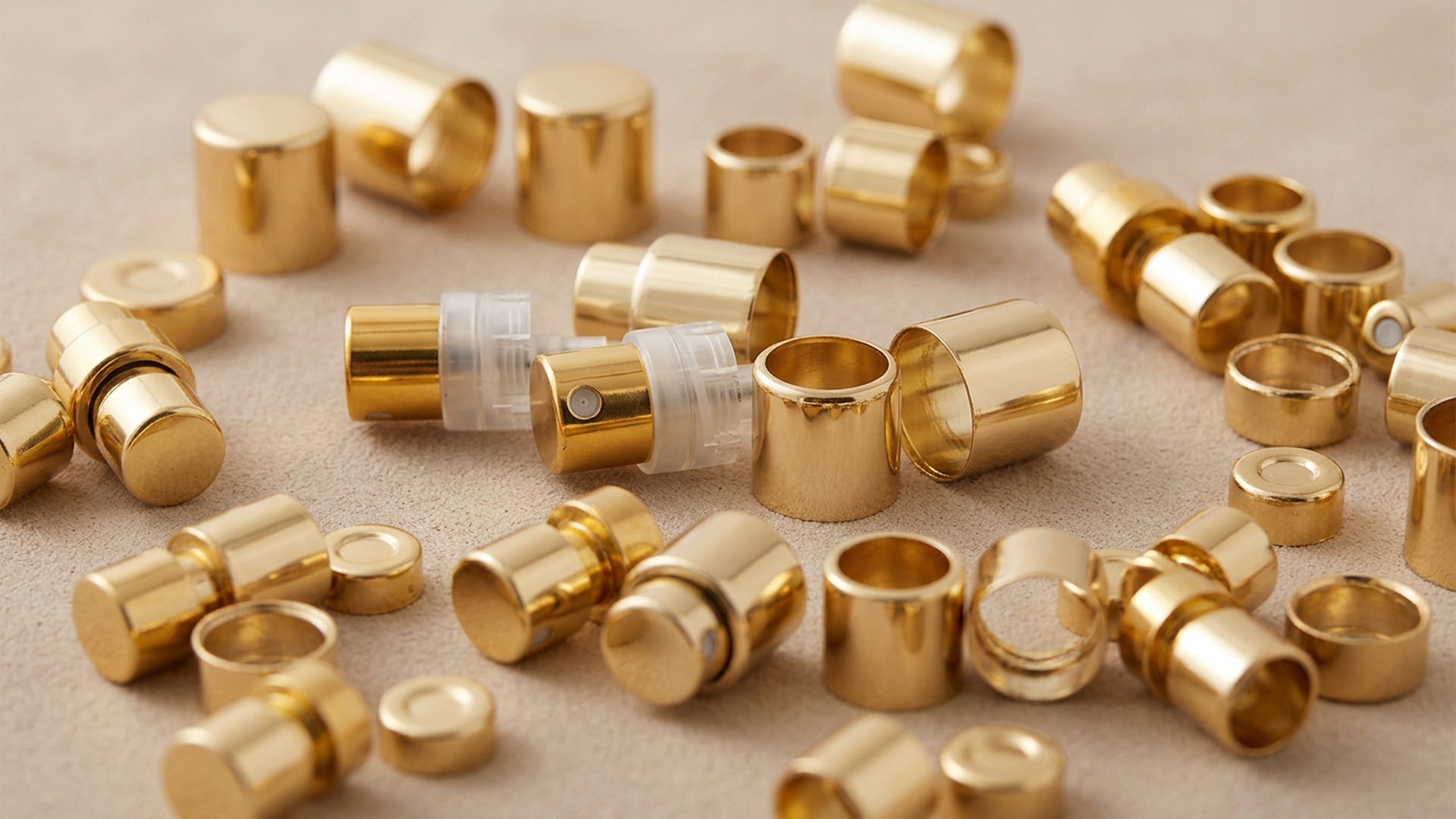
| Pump collar | Aluminium (silver, gold, matte, brushed), plastic |
| Decoration | Spray coating, UV electroplating, hot stamping, silk-screen, pad printing, laser engraving, decal |
5. Can you refill a perfume bottle?
Yes — most of the time. There are three realistic methods:
- Brand refill service. Houses like Mugler, Guerlain, Hermès and Diptyque sell large refill bottles or offer in-boutique refilling.
- Travel atomizer transfer. Press a 5 ml refillable atomizer onto your full-size bottle''s spray nozzle and pump 10–15 times. Works on any standard FEA 15 pump.
- DIY decant with a funnel. Only possible if the original pump unscrews (some screw-neck bottles) — crimped pumps cannot be removed without destroying them.
Why refill? A reusable bottle saves 50–100 g of glass and aluminium per purchase, and a quality flacon can last a decade.
6. Travel rules: are perfume atomizers TSA-legal?
Yes — any atomizer 100 ml (3.4 fl oz) or smaller is allowed in carry-on, as long as it fits in your single quart-size liquids bag (US TSA) or 1-litre liquids bag (EU / UK / most of the world). Refillable 5 ml and 10 ml atomizers are the easiest way to travel with a luxury fragrance you don''t want to risk in checked luggage.
In checked luggage there''s technically no size limit, but airlines restrict total alcohol-based fragrance to ~2 litres / 2 kg per passenger (IATA Packing Instruction 960) because perfume is a flammable liquid.
7. Gifting: why bottle design matters
Perfume is one of the most-given gifts worldwide because the bottle itself is the gift object — it sits on a vanity, a dresser, a desk. For 2026 the trends lean toward:
- Sculptural heavy-base flacons with metal or Zamac caps
- Frosted pastel glass (sage, blush, sand) with matching cap
- Refillable architecture — gifting feels less wasteful when the bottle is built to last
- Personalisation — engraved initials, custom labels, made-to-order colour
- Coffret sets with a full-size bottle + matching 10 ml travel atomizer
8. How brands actually source perfume bottles & atomizers
If you''re launching a fragrance line, here''s the realistic supply chain:
| Step | Detail |
|---|---|
| Stock vs custom | Stock moulds: MOQ 5,000 pcs, ships in 30–45 days. Custom mould: MOQ 20,000–30,000 pcs, mould cost USD 2,000–8,000, total lead time 3–4 months. |
| Pump sourcing | FEA 15 crimp pumps from Aptar, Coster, Silgan or Asian equivalents. Always match pump throw (0.07 / 0.10 / 0.14 ml) to bottle size. |
| Decoration | Spray coat + hot stamp logo is the most common combo. UV electroplating gives a true mirror finish. |
| QC | AQL 2.5 for cosmetic defects, AQL 4.0 for functional defects, with IPQC, final, and pre-shipment inspections. |
| Packing | EPE foam inner trays + 5-layer corrugated cartons, on EUR or US pallets. |
| Shipping | FOB Shanghai or Ningbo. A 20ft container holds roughly 30,000–45,000 × 100 ml bottles depending on cap and packing. |
For a full breakdown see our Custom Glass Perfume Bottle Manufacturing Guide and our Weight and Volume Conversion reference.
9. How to care for your perfume bottle
- Keep upright, away from direct sunlight and heat (bathroom shelves are the worst place).
- Don''t shake — agitation introduces oxygen and accelerates oxidation.
- Store between 15–22 °C for maximum shelf life (typically 3–5 years unopened, 1–3 years after opening).
- Wipe the nozzle occasionally — sugar from accidental spray on fabric can clog the pump.
Frequently asked questions
Q: What''s the difference between a perfume bottle and an atomizer? A bottle stores the fragrance; an atomizer is the spray mechanism on top. Most modern perfume bottles ship with the atomizer (FEA 15 crimp pump) already crimped on. ''Atomizer'' on its own usually refers to a small refillable travel sprayer (5–10 ml).
Q: Can you refill any perfume bottle? Only screw-neck bottles can be unscrewed and refilled directly. Crimp-pump bottles (the vast majority) must be refilled with a travel atomizer that presses onto the existing nozzle.
Q: Are perfume atomizers allowed on planes? Yes — under 100 ml (3.4 fl oz) in carry-on, inside your single liquids bag. Refillable 5 ml and 10 ml atomizers are designed for this.
Q: What size perfume bottle should I buy? Casual users: 30–50 ml (lasts 1–2 years). Daily wearers: 100 ml. Collectors / signature scents: 75–100 ml plus a 10 ml travel atomizer.
Q: Are vintage perfume bottles valuable? Hand-blown crystal flacons (Lalique, Baccarat, vintage Guerlain) regularly sell for hundreds to thousands of dollars. Standard 1990s–2010s designer bottles usually aren''t collectible unless sealed and full.
Q: Where can brands buy custom perfume bottles and atomizers in bulk? From specialist Chinese glass and packaging manufacturers. Jiangsu Rango Packaging has produced custom perfume bottles, atomizers and decoration for clients in 60+ countries since 2014 — browse the catalogue or request a custom mould quote.